Loading...
Searching...
No Matches
Linked List API
Doubly linked list utilities. More...
Functions | |
| t_node * | node_new (void *content, t_node *prev, t_node *next) |
| Creates a new list node. | |
| void | node_free (t_node **node, void(*del_content)(void *)) |
| Frees a node and optionally its content. | |
| bool | list_add_end (t_list *list, void *new_content) |
| Adds a new element at the end of the list. | |
| bool | list_add_start (t_list *list, void *new_content) |
| Adds a new element at the start of the list. | |
| size_t | list_get_size (t_list list) |
| Calculates the number of nodes in the list. | |
| void * | list_get_content (t_list list, bool(*select_function)(void *)) |
| Finds content in list matching a selection function. | |
| void * | list_get_content_n (t_list list, size_t index) |
| Gets content at a specific index in the list. | |
| void * | list_get_content_last (t_list list) |
| Gets the content of the last node in the list. | |
| t_node * | list_get_node_n (t_list list, size_t index) |
| Gets the node at a specific index in the list. | |
| t_node * | list_get_node_last (t_list list) |
| Gets the last node in the list. | |
| void | list_iter (t_list lst, void(*f)(void *)) |
| Applies a function to each element of the list. | |
| t_list | list_map (t_list list, void *(*f)(void *), void(*del)(void *)) |
| Creates a new list by applying a function to each element. | |
| void | list_rm (t_list *list, t_node *node, void(*del_content)(void *)) |
| Removes a specific node from the list. | |
| void | list_rm_all (t_list *list, void(*del_content)(void *)) |
| Removes all nodes from the list. | |
Detailed Description
Doubly linked list utilities.
Functions to create, manipulate and traverse doubly linked lists.
Function Documentation
◆ list_add_end()
| bool list_add_end | ( | t_list * | list, |
| void * | new_content | ||
| ) |
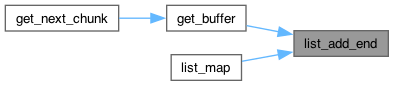
Adds a new element at the end of the list.
- Note
- Ownership of new_content is transferred to the list on success. On failure, caller retains ownership of new_content.
- Parameters
-
list Pointer to the list pointer (borrowed). new_content Content for the new node (ownership transferred).
- Returns
- true on success, false on allocation failure.
Here is the call graph for this function:

Here is the caller graph for this function:
◆ list_add_start()
| bool list_add_start | ( | t_list * | list, |
| void * | new_content | ||
| ) |
Adds a new element at the start of the list.
- Note
- Ownership of new_content is transferred to the list on success. On failure, caller retains ownership of new_content.
- Parameters
-
list Pointer to the list pointer (borrowed). new_content Content for the new node (ownership transferred).
- Returns
- true on success, false on allocation failure.
Here is the call graph for this function:

◆ list_get_content()
| void * list_get_content | ( | t_list | list, |
| bool(*)(void *) | select_function | ||
| ) |
Finds content in list matching a selection function.
- Note
- Returned pointer is borrowed from the list. Do not free it directly; the list retains ownership. Pointer becomes invalid if node is removed.
- Parameters
-
list List to search (borrowed). select_function Function returning true for desired content.
- Returns
- Matching content (borrowed), or NULL if not found.
◆ list_get_content_last()
| void * list_get_content_last | ( | t_list | list | ) |
Gets the content of the last node in the list.
- Note
- Returned pointer is borrowed from the list. Do not free it directly; the list retains ownership. Pointer becomes invalid if node is removed.
- Parameters
-
list List to search (borrowed).
- Returns
- Content of last node (borrowed), or NULL if list is empty.
Here is the call graph for this function:

◆ list_get_content_n()
| void * list_get_content_n | ( | t_list | list, |
| size_t | index | ||
| ) |
Gets content at a specific index in the list.
- Note
- Returned pointer is borrowed from the list. Do not free it directly; the list retains ownership. Pointer becomes invalid if node is removed.
- Parameters
-
list List to search (borrowed). index Zero-based index.
- Returns
- Content at index (borrowed), or NULL if index out of bounds.
Here is the call graph for this function:

◆ list_get_node_last()
Gets the last node in the list.
- Note
- Returned pointer is borrowed from the list. Do not free it directly; the list retains ownership. Pointer becomes invalid if node is removed.
- Parameters
-
list List to search (borrowed).
- Returns
- Last node (borrowed), or NULL if list is empty.
Here is the caller graph for this function:

◆ list_get_node_n()
Gets the node at a specific index in the list.
- Note
- Returned pointer is borrowed from the list. Do not free it directly; the list retains ownership. Pointer becomes invalid if node is removed.
- Parameters
-
list List to search (borrowed). index Zero-based index.
- Returns
- Node at index (borrowed), or NULL if index out of bounds.
Here is the caller graph for this function:

◆ list_get_size()
| size_t list_get_size | ( | t_list | list | ) |
Calculates the number of nodes in the list.
- Parameters
-
list List to count.
- Returns
- Number of nodes in the list.
◆ list_iter()
| void list_iter | ( | t_list | lst, |
| void(*)(void *) | f | ||
| ) |
Applies a function to each element of the list.
- Parameters
-
lst List to iterate over (borrowed). f Function to apply to each element's content.
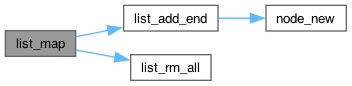
◆ list_map()
Creates a new list by applying a function to each element.
- Note
- Caller owns the returned list and must free it with list_rm_all.
- Parameters
-
list Source list (borrowed). f Function to apply to each element (returns new content, owned). del Function to delete content on failure.
- Returns
- New list (owned), or NULL on failure.
Here is the call graph for this function:
◆ list_rm()
Removes a specific node from the list.
- Parameters
-
list Pointer to the list pointer (borrowed). node Node to remove (ownership taken, will be freed). del_content Function to delete the node's content (can be NULL).
Here is the caller graph for this function:

◆ list_rm_all()
| void list_rm_all | ( | t_list * | list, |
| void(*)(void *) | del_content | ||
| ) |
Removes all nodes from the list.
- Parameters
-
list Pointer to the list pointer (set to NULL after). del_content Function to delete each node's content (can be NULL).
Here is the caller graph for this function:

◆ node_free()
| void node_free | ( | t_node ** | node, |
| void(*)(void *) | del_content | ||
| ) |
Frees a node and optionally its content.
- Parameters
-
node Pointer to the node pointer (set to NULL after freeing). del_content Function to delete the content (can be NULL to skip).
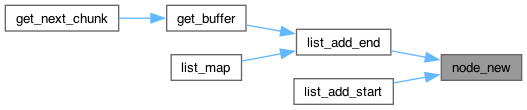
◆ node_new()
Creates a new list node.
- Note
- Ownership of content is transferred to the node on success.
- Parameters
-
content Content for the new node (ownership transferred). prev Pointer to the previous node (borrowed, can be NULL). next Pointer to the next node (borrowed, can be NULL).
- Returns
- Pointer to the new node (owned), or NULL on allocation failure.
Here is the caller graph for this function: