|
| t_btree_node * | btree_new (void *data) |
| | Creates a new binary tree node.
|
| |
| void | btree_set_left (t_btree_node *parent, t_btree_node *child) |
| | Sets the left child of a parent node.
|
| |
| void | btree_set_right (t_btree_node *parent, t_btree_node *child) |
| | Sets the right child of a parent node.
|
| |
| t_btree_node * | btree_detach_left (t_btree_node *parent) |
| | Detaches and returns the left child of a parent node.
|
| |
| t_btree_node * | btree_detach_right (t_btree_node *parent) |
| | Detaches and returns the right child of a parent node.
|
| |
| void | btree_free (t_btree_node **node, void(*data_free)(void *data)) |
| | Recursively frees a node and its descendants.
|
| |
| bool | buff_adjust (t_buff *buff) |
| | Shrinks buffer capacity to match its current length.
|
| |
| bool | buff_append (t_buff *dst, const t_buff *src) |
| | Appends the content of a source buffer to the end of a buffer.
|
| |
| bool | buff_append_format (t_buff *buff, const char *fstring,...) |
| | Appends formatted string to buffer using variadic arguments.
|
| |
| bool | buff_append_n (t_buff *b, const char *str, long n) |
| | Appends n first bytes of a string to the end of the buffer.
|
| |
| bool | buff_append_vformat (t_buff *buff, const char *fstring, va_list args) |
| | Appends formatted string to buffer using va_list.
|
| |
| bool | buff_cmp (const t_buff *a, const t_buff *b) |
| | Compares two buffers data byte by byte.
|
| |
| bool | buff_dup (t_buff *dst, const t_buff *src) |
| | Copies the content of a source buffer into an existing buffer.
|
| |
| bool | buff_dup_n (t_buff *dst, const t_buff *src, size_t n) |
| | Copies up to n bytes from a source buffer into an existing buffer.
|
| |
| void | buff_free (t_buff *buff) |
| | Frees the buffer's internal data.
|
| |
| void | buff_free_void (void *buff) |
| | Frees a t_buff item through a generic void* callback signature.
|
| |
| ssize_t | buff_get_index_c (const t_buff *buff, char c) |
| | Finds the index of the first occurrence of a character in the buffer.
|
| |
| ssize_t | buff_get_index_s (const t_buff *buff, const char *s, ssize_t slen) |
| | Finds the first occurrence of a substring in the buffer.
|
| |
| char * | buff_get_string (const t_buff *buff) |
| | Returns a newly allocated copy of the buffer content.
|
| |
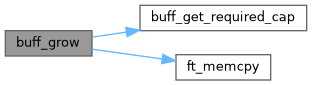
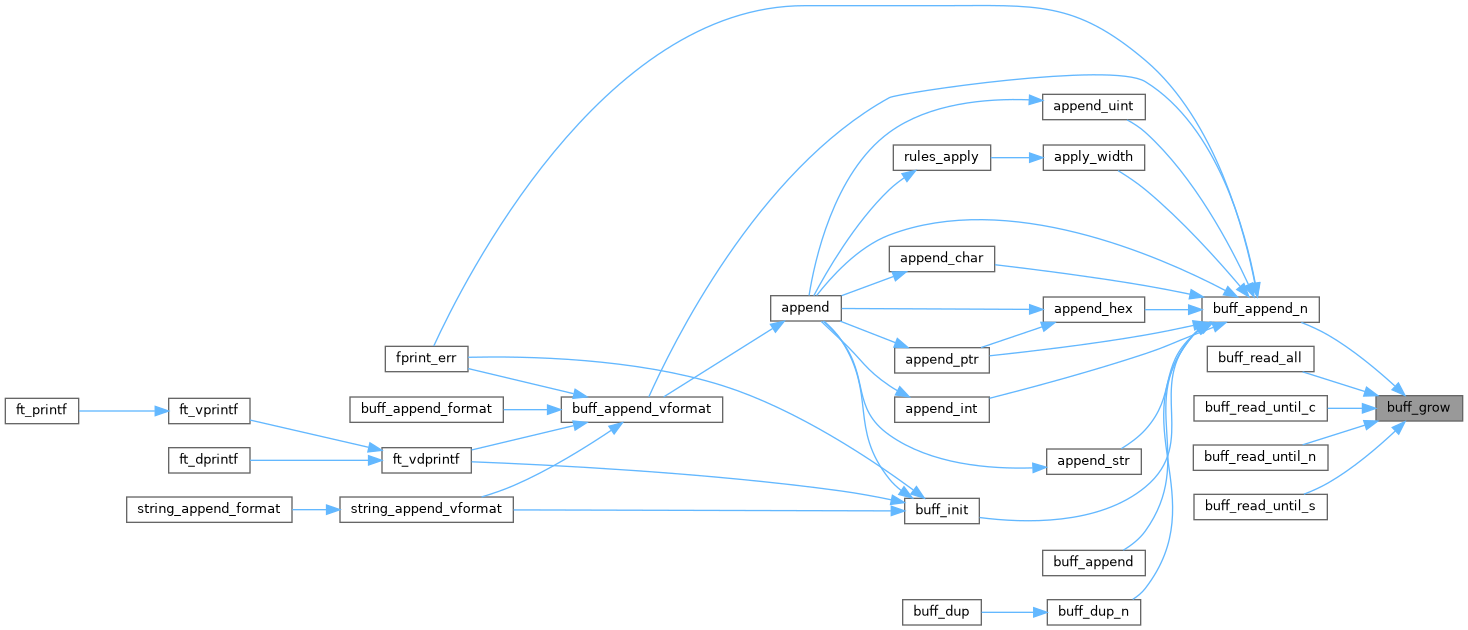
| bool | buff_grow (t_buff *buff, size_t target_len) |
| | Grows the buffer to accommodate the target length if necessary.
|
| |
| bool | buff_init (t_buff *buff, size_t initial_cap, const char *str, long n) |
| | Initializes a buffer with the specified initial capacity.
|
| |
| bool | buff_insert (t_buff *dst, size_t index, const t_buff *src) |
| | Inserts a source buffer in a buffer at the specified index.
|
| |
| bool | buff_insert_n (t_buff *b, size_t index, const char *str, long n) |
| | Inserts n first bytes of a string in the buffer at specified index.
|
| |
| bool | buff_prepend (t_buff *dst, const t_buff *src) |
| | Prepends a source buffer to the beginning of a buffer.
|
| |
| bool | buff_prepend_n (t_buff *b, const char *str, long n) |
| | Prepends n first bytes of a string to the beginning of the buffer.
|
| |
| bool | buff_read_all (t_buff *buff, int fd) |
| | Reads all available data from a file descriptor into buffer.
|
| |
| bool | buff_read_until_c (t_buff *buff, int fd, char c) |
| | Reads from a file descriptor until a specific character is found.
|
| |
| bool | buff_read_until_n (t_buff *buff, int fd, size_t n) |
| | Reads up to n bytes from a file descriptor into buffer.
|
| |
| bool | buff_read_until_s (t_buff *buff, int fd, const char *s, ssize_t slen) |
| | Reads from a file descriptor until a specific substring is found.
|
| |
| void | buff_rm_part (t_buff *buff, size_t i_start, ssize_t len) |
| | Removes a portion of the buffer starting at i_start.
|
| |
| int | ft_isalnum (int c) |
| | Checks if a character is alphanumeric.
|
| |
| int | ft_isalpha (int c) |
| | Checks if a character is alphabetic.
|
| |
| int | ft_isascii (int c) |
| | Checks if a character is a valid ASCII character (0-127).
|
| |
| int | ft_isdigit (int c) |
| | Checks if a character is a digit ('0'-'9').
|
| |
| bool | ft_isincharset (char c, const char *charset) |
| | Checks if a character is present in a character set.
|
| |
| int | ft_isprint (int c) |
| | Checks if a character is printable (32-126).
|
| |
| int | ft_isspace (char c) |
| | Checks if a character is whitespace (9-13).
|
| |
| int | ft_tolower (int c) |
| | Converts an uppercase letter to lowercase.
|
| |
| int | ft_toupper (int c) |
| | Converts a lowercase letter to uppercase.
|
| |
| int | ft_atoi (const char *str) |
| | Converts a string to an integer.
|
| |
| long | ft_atol (const char *str) |
| | Converts a string to a long integer.
|
| |
| pid_t | ft_atopid (const char *str) |
| | Converts a string to a pid_t.
|
| |
| size_t | ft_atozu (const char *str) |
| | Converts a string to a size_t.
|
| |
| char * | ft_itoa (int n) |
| | Converts an integer to a string.
|
| |
| char * | ft_utoa (unsigned int n) |
| | Converts an unsigned integer to a string.
|
| |
| char * | ft_zutoa (size_t n) |
| | Converts a size_t to a string.
|
| |
| char * | ft_ltoa (long n) |
| | Converts a long integer to a string.
|
| |
| char * | ft_pidtoa (pid_t n) |
| | Converts a pid_t to a string.
|
| |
| char * | ft_ultoa_base (unsigned long n, const char *base) |
| | Converts an unsigned long to a string in a given base.
|
| |
| bool | parse_int (char *s, int *out) |
| | Parses a string to an integer with overflow detection.
|
| |
| bool | parse_long (char *s, long *out) |
| | Parses a string to a long with overflow detection.
|
| |
| void | print_err (bool print_errno, const char *message) |
| | Prints "Error\n" to stderr with optional message and errno.
|
| |
| void | fprint_err (bool print_errno, const char *safe, const char *fmt,...) |
| | Prints "Error\n" to stderr with safe prefix + formatted suffix.
|
| |
| bool | hashmap_init (t_hashmap *map, size_t initial_cap, void(*del)(void *)) |
| | Initializes an empty hash map.
|
| |
| void | hashmap_free (t_hashmap *map) |
| | Frees a hash map and all of its contents.
|
| |
| void | hashmap_clear (t_hashmap *map) |
| | Removes all key/value pairs from a hash map.
|
| |
| bool | hashmap_put (t_hashmap *map, const char *key, void *value) |
| | Inserts a key/value pair, replacing any existing value for the key.
|
| |
| void * | hashmap_get (const t_hashmap *map, const char *key) |
| |
| const void * | hashmap_get_const (const t_hashmap *map, const char *key) |
| | Retrieves the value associated with a key.
|
| |
| const t_key_value ** | hashmap_get_all (const t_hashmap *map) |
| | Collects every key/value pair stored in the map.
|
| |
| bool | hashmap_remove (t_hashmap *map, const char *key) |
| | Removes the pair associated with a key.
|
| |
| bool | hashmap_contains (const t_hashmap *map, const char *key) |
| | Tests whether a key is present in the map.
|
| |
| t_key_value * | key_value_new (const char *key, void *value) |
| | Allocates a key/value pair.
|
| |
| void | key_value_free (t_key_value **pair, void(*del)(void *)) |
| | Frees a key/value pair and its contents.
|
| |
| t_node * | node_new (void *content, t_node *prev, t_node *next) |
| | Creates a new list node.
|
| |
| void | node_free (t_node **node, void(*del_content)(void *)) |
| | Frees a node and optionally its content.
|
| |
| bool | list_add_end (t_list *list, void *new_content) |
| | Adds a new element at the end of the list.
|
| |
| bool | list_add_start (t_list *list, void *new_content) |
| | Adds a new element at the start of the list.
|
| |
| size_t | list_get_size (t_list list) |
| | Calculates the number of nodes in the list.
|
| |
| void * | list_get_content (t_list list, bool(*select_function)(void *)) |
| | Finds content in list matching a selection function.
|
| |
| void * | list_get_content_n (t_list list, size_t index) |
| | Gets content at a specific index in the list.
|
| |
| void * | list_get_content_last (t_list list) |
| | Gets the content of the last node in the list.
|
| |
| t_node * | list_get_node_n (t_list list, size_t index) |
| | Gets the node at a specific index in the list.
|
| |
| t_node * | list_get_node_last (t_list list) |
| | Gets the last node in the list.
|
| |
| void | list_iter (t_list lst, void(*f)(void *)) |
| | Applies a function to each element of the list.
|
| |
| t_list | list_map (t_list list, void *(*f)(void *), void(*del)(void *)) |
| | Creates a new list by applying a function to each element.
|
| |
| void | list_rm (t_list *list, t_node *node, void(*del_content)(void *)) |
| | Removes a specific node from the list.
|
| |
| void | list_rm_all (t_list *list, void(*del_content)(void *)) |
| | Removes all nodes from the list.
|
| |
| void * | ft_calloc (size_t count, size_t size) |
| | Allocates and zeroes memory for an array.
|
| |
| bool | ft_realloc (char **buff, size_t cap, size_t newcap) |
| | Reallocates a buffer to a new capacity.
|
| |
| long | min (long a, long b) |
| | Returns the minimum of two long integers.
|
| |
| long | max (long a, long b) |
| | Returns the maximum of two long integers.
|
| |
| size_t | absolute (long nbr) |
| | Returns the absolute value of a long integer.
|
| |
| long | power (int a, int b) |
| | Computes a raised to the power of b.
|
| |
| size_t | modulo (long a, size_t b) |
| | Computes the modulo of a signed integer with an unsigned modulus.
|
| |
| int | square_root_exact (int nb) |
| | Calculates the exact integer square root.
|
| |
| int | square_root_rounded (int nb) |
| | Calculates the nearest integer square root.
|
| |
| void | ft_bzero (void *s, size_t n) |
| | Sets n bytes of memory to zero.
|
| |
| void * | ft_memchr (const void *s, int c, size_t n) |
| | Locates the first occurrence of a byte in memory.
|
| |
| int | ft_memcmp (const void *s1, const void *s2, size_t n) |
| | Compares two memory areas byte by byte.
|
| |
| void * | ft_memcpy (void *dst, const void *src, size_t n) |
| | Copies n bytes from src to dst.
|
| |
| void * | ft_memmove (void *dst, const void *src, size_t len) |
| | Copies n bytes from src to dst, handling overlapping memory.
|
| |
| void * | ft_memset (void *b, int c, size_t len) |
| | Fills memory with a constant byte.
|
| |
| int | ft_vdprintf (int fd, const char *fstring, va_list args) |
| | Writes formatted output to a file descriptor using va_list.
|
| |
| int | ft_dprintf (int fd, const char *fstring,...) |
| | Writes formatted output to a file descriptor.
|
| |
| int | ft_vprintf (const char *fstring, va_list args) |
| | Writes formatted output to stdout using va_list.
|
| |
| int | ft_printf (const char *fstring,...) |
| | Writes formatted output to stdout.
|
| |
| void | ft_putchar_fd (char c, int fd) |
| | Writes a character to a file descriptor.
|
| |
| void | ft_putendl_fd (char *s, int fd) |
| | Writes a string followed by newline to a file descriptor.
|
| |
| void | ft_putnbr_fd (int n, int fd) |
| | Writes an integer to a file descriptor.
|
| |
| void | ft_putstr_fd (char *s, int fd) |
| | Writes a string to a file descriptor.
|
| |
| void | str_array_free (char ***tab_ptr) |
| | Frees all strings in a null-terminated array and the tab itself.
|
| |
| char * | str_chr (const char *s, int c) |
| | Locates the first occurrence of a character in a string.
|
| |
| int | str_cmp (const char *s1, const char *s2) |
| | Compares two strings.
|
| |
| size_t | str_count_words (char const *s, char sep) |
| | Counts words in a string separated by a delimiter.
|
| |
| char * | str_dup (const char *s1) |
| | Duplicates a string.
|
| |
| void | str_iteri (char *s, void(*f)(unsigned int, char *)) |
| | Applies a function to each character of a string with its index.
|
| |
| char * | str_join (char const *s1, char const *s2) |
| | Concatenates two strings into a new string.
|
| |
| size_t | str_lcat (char *dst, const char *src, size_t dstsize) |
| | Appends src to dst with size limit.
|
| |
| size_t | str_lcpy (char *dst, const char *src, size_t dstsize) |
| | Copies src to dst with size limit.
|
| |
| size_t | str_len (const char *s) |
| | Calculates the length of a string.
|
| |
| char * | str_mapi (char const *s, char(*f)(unsigned int, char)) |
| | Creates a new string by applying a function to each character.
|
| |
| int | str_ncmp (const char *s1, const char *s2, size_t n) |
| | Compares at most n characters of two strings.
|
| |
| char * | str_ndup (const char *src, size_t len) |
| | Duplicates the first len bytes of a string.
|
| |
| char * | str_nstr (const char *haystack, const char *needle, size_t len) |
| | Locates a substring within a string, limited by length.
|
| |
| char * | str_rchr (const char *s, int c) |
| | Locates the last occurrence of a character in a string.
|
| |
| char ** | str_split (char const *s, char c) |
| | Splits a string into an array of strings using a delimiter.
|
| |
| char * | str_sub (char const *s, unsigned int start, size_t len) |
| | Extracts a substring from a string.
|
| |
| char * | str_trim (char const *s1, char const *set) |
| | Trims characters from the beginning and end of a string.
|
| |
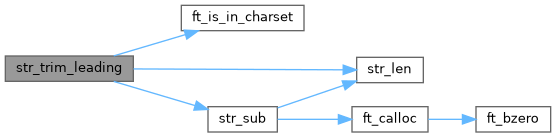
| char * | str_trim_leading (char const *s1, char const *set) |
| |
| bool | string_adjust (t_string *string) |
| | Shrinks string capacity to match its current length plus NUL byte.
|
| |
| bool | string_append (t_string *dst, const t_string *src) |
| | Appends the content of a source string to the end of a string.
|
| |
| bool | string_append_format (t_string *string, const char *fstring,...) |
| | Appends formatted text to string using variadic arguments.
|
| |
| bool | string_append_n (t_string *s, const char *str, long n) |
| | Appends n first bytes of a string to the end of a dynamic string.
|
| |
| bool | string_append_vformat (t_string *string, const char *fstring, va_list args) |
| | Appends formatted text to string using va_list.
|
| |
| bool | string_cmp (const t_string *a, const t_string *b) |
| | Compares two strings byte by byte.
|
| |
| bool | string_dup (t_string *dst, const t_string *src) |
| | Copies the content of a source string into an existing string.
|
| |
| bool | string_dup_n (t_string *dst, const t_string *src, size_t n) |
| | Copies up to n bytes from a source string into an existing string.
|
| |
| void | string_free (t_string *string) |
| | Frees the string's internal data.
|
| |
| void | string_free_void (void *string) |
| | Frees a t_string item through a generic void* callback signature.
|
| |
| ssize_t | string_get_index_c (const t_string *string, char c) |
| | Finds the index of the first occurrence of a character in the string.
|
| |
| ssize_t | string_get_index_s (const t_string *string, const char *s, ssize_t slen) |
| | Finds the first occurrence of a substring in the string.
|
| |
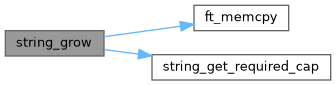
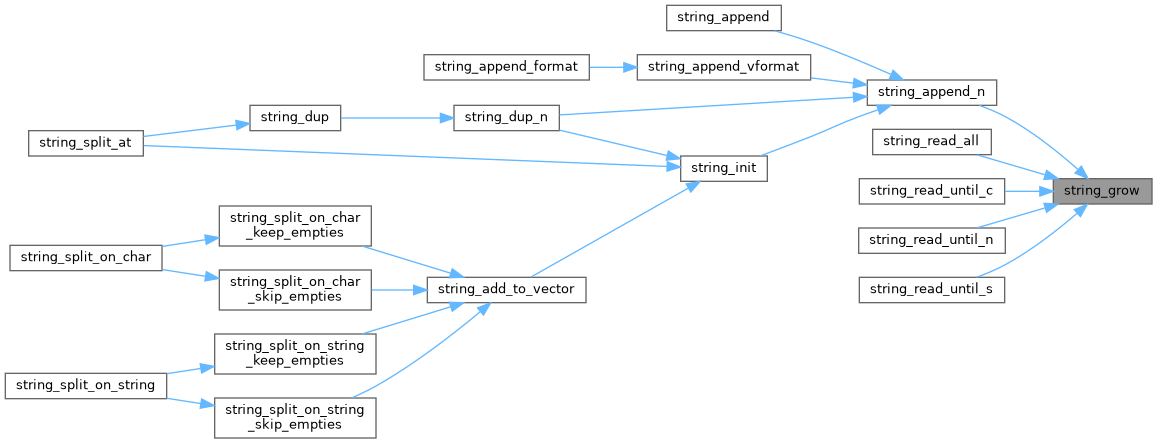
| bool | string_grow (t_string *string, size_t target_cap) |
| | Grows the string to accommodate the target length if necessary.
|
| |
| bool | string_init (t_string *s, size_t initial_cap, const char *str, long n) |
| | Initializes a string with the specified initial capacity.
|
| |
| bool | string_insert (t_string *dst, size_t index, const t_string *src) |
| | Inserts a source string in a string at the specified index.
|
| |
| bool | string_insert_n (t_string *s, size_t index, const char *str, long n) |
| | Inserts n first bytes of a string at the specified index.
|
| |
| bool | string_prepend (t_string *dst, const t_string *src) |
| | Prepends a source string to the beginning of a string.
|
| |
| bool | string_prepend_n (t_string *s, const char *str, long n) |
| | Prepends n first bytes of a string to the beginning of a string.
|
| |
| bool | string_read_all (t_string *string, int fd) |
| | Reads all available data from a file descriptor into string.
|
| |
| bool | string_read_until_c (t_string *string, int fd, char c) |
| | Reads from a file descriptor until a specific character is found.
|
| |
| bool | string_read_until_n (t_string *string, int fd, size_t n) |
| | Reads up to n bytes from a file descriptor into string.
|
| |
| bool | string_read_until_s (t_string *string, int fd, const char *s, ssize_t slen) |
| | Reads from a file descriptor until a specific substring is found.
|
| |
| void | string_rm_part (t_string *string, size_t i_start, ssize_t len) |
| | Removes a portion of the string starting at i_start.
|
| |
| bool | string_split_at (const t_string *src, size_t index, t_string *out_before, t_string *out_after) |
| | Splits a string into two initialized strings at a byte index.
|
| |
| bool | string_split_on_char (const t_string *src, char c, bool keep_empty_entries, t_vector *out) |
| | Splits a string on a delimiter character into a t_vector.
|
| |
| bool | string_split_on_string (const t_string *src, const char *sep, bool keep_empty_entries, t_vector *out) |
| | Splits a string on a delimiter C-string into a t_vector.
|
| |
| void | string_take (t_string *dst, char *src, size_t cap, ssize_t len) |
| | Installs an existing buffer in a string without copying it.
|
| |
| void | string_take_string (t_string *dst, t_string *src) |
| | Move the internal storage of one string into another string.
|
| |
| void | string_trim_leading (t_string *string, char c) |
| | Removes leading copies of a character from a string.
|
| |
| bool | vector_init (t_vector *vector, size_t item_size, size_t cap) |
| | Initializes a vector with a given item size and initial capacity.
|
| |
| bool | vector_grow (t_vector *vector) |
| | Grows vector capacity, usually by doubling it.
|
| |
| bool | vector_adjust (t_vector *vector) |
| | Shrinks vector capacity to match its current length.
|
| |
| bool | vector_dup (t_vector *dst, const t_vector *src) |
| | Duplicates a vector into another one.
|
| |
| void | vector_free (t_vector *vector, void(*item_free)(void *item)) |
| | Frees the vector's internal storage.
|
| |
| void | vector_clear (t_vector *vector, void(*del)(void *)) |
| | Removes all items from a vector without freeing its storage.
|
| |
| bool | vector_push (t_vector *vector, const void *item) |
| | Appends one item at the end of the vector.
|
| |
| bool | vector_pop (t_vector *vector, void *dst) |
| | Removes the last item from the vector.
|
| |
| bool | vector_insert (t_vector *vector, size_t index, const void *item) |
| | Inserts one item at a specific index.
|
| |
| bool | vector_remove (t_vector *vector, size_t index, void *dst) |
| | Removes one item at a specific index.
|
| |
| void | vector_take (t_vector *dst, t_vector *src) |
| | Transfers a vector state into another one without copying items.
|
| |
| bool | vector_merge (t_vector *dst, const t_vector *src, size_t index) |
| | Inserts all items from src into dst at a specific index.
|
| |