Dynamic array utilities for contiguous fixed-size items. More...
Functions | |
| bool | vector_init (t_vector *vector, size_t item_size, size_t cap) |
| Initializes a vector with a given item size and initial capacity. | |
| bool | vector_grow (t_vector *vector) |
| Grows vector capacity, usually by doubling it. | |
| bool | vector_adjust (t_vector *vector) |
| Shrinks vector capacity to match its current length. | |
| bool | vector_dup (t_vector *dst, const t_vector *src) |
| Duplicates a vector into another one. | |
| void | vector_free (t_vector *vector, void(*item_free)(void *item)) |
| Frees the vector's internal storage. | |
| void | vector_clear (t_vector *vector, void(*del)(void *)) |
| Removes all items from a vector without freeing its storage. | |
| bool | vector_push (t_vector *vector, const void *item) |
| Appends one item at the end of the vector. | |
| bool | vector_pop (t_vector *vector, void *dst) |
| Removes the last item from the vector. | |
| bool | vector_insert (t_vector *vector, size_t index, const void *item) |
| Inserts one item at a specific index. | |
| bool | vector_remove (t_vector *vector, size_t index, void *dst) |
| Removes one item at a specific index. | |
| void | vector_take (t_vector *dst, t_vector *src) |
| Transfers a vector state into another one without copying items. | |
| bool | vector_merge (t_vector *dst, const t_vector *src, size_t index) |
| Inserts all items from src into dst at a specific index. | |
Detailed Description
Dynamic array utilities for contiguous fixed-size items.
Functions to initialize, grow, shrink, duplicate and manipulate dynamic arrays storing items contiguously in memory.
Function Documentation
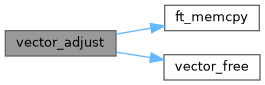
◆ vector_adjust()
| bool vector_adjust | ( | t_vector * | vector | ) |
Shrinks vector capacity to match its current length.
Existing items are preserved. If vector length is 0, internal storage is freed.
- Warning
- vector must be initialized before calling this function.
- Parameters
-
vector Pointer to an initialized vector (borrowed).
- Returns
- true on success, false on allocation failure.
◆ vector_clear()
| void vector_clear | ( | t_vector * | vector, |
| void(*)(void *) | del | ||
| ) |
Removes all items from a vector without freeing its storage.
If del is not NULL, it is called once for each stored item before the vector length is reset to 0. The callback receives a pointer to the item slot inside the vector storage.
- Warning
vectormust be initialized before calling this function.
- Parameters
-
vector Pointer to an initialized vector (borrowed). del Optional callback applied to each stored item before clearing (borrowed, read-only).
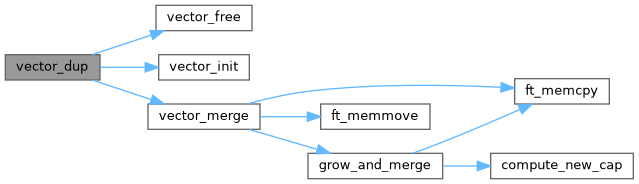
◆ vector_dup()
Duplicates a vector into another one.
A new internal storage is allocated for dst. Items are copied byte-for-byte; item payloads themselves are not deep-copied.
- Note
- On success, dst is initialized and owns its internal storage. Caller must later release it with vector_free().
- Warning
- dst must NOT be initialized, or must be freed before calling this function.
- dst and src must be different.
- Parameters
-
dst Destination vector to initialize and fill (borrowed). src Source vector to duplicate (borrowed).
- Returns
- true on success, false on failure.
◆ vector_free()
| void vector_free | ( | t_vector * | vector, |
| void(*)(void *item) | item_free | ||
| ) |
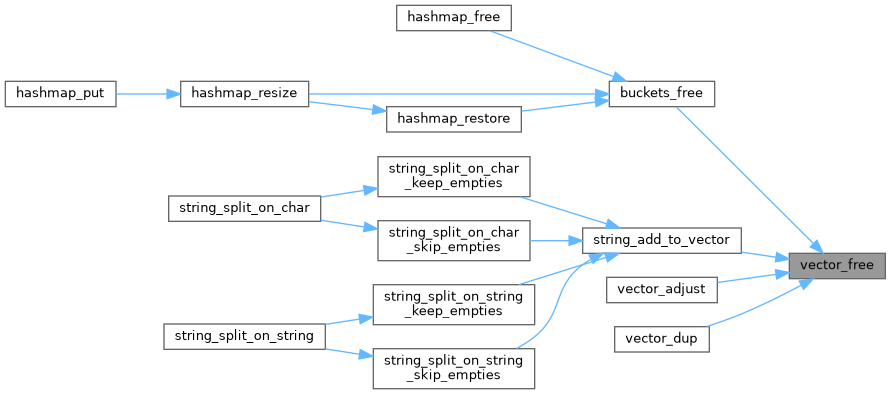
Frees the vector's internal storage.
Calls item_free on each stored item when provided. Frees vector->data only when vector owns its storage, that is when vector->cap is greater than 0. Then sets vector->data to NULL and vector->len and vector->cap to 0.
- Warning
- Does not free the t_vector struct itself, only its internal data.
- Parameters
-
vector Pointer to the vector (borrowed). item_free Optional callback to free each item (can be NULL).
◆ vector_grow()
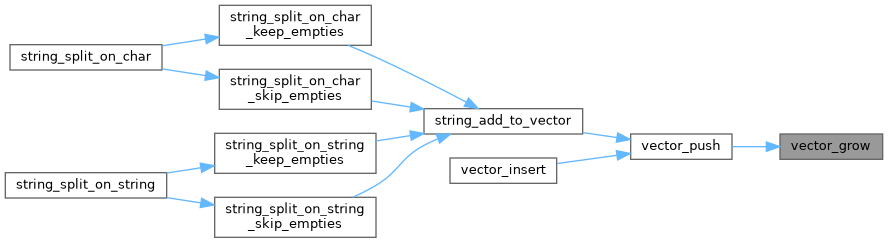
| bool vector_grow | ( | t_vector * | vector | ) |
Grows vector capacity, usually by doubling it.
Existing items are preserved. If current capacity is 0, grows to VECTOR_INIT_CAP.
- Warning
- vector must be initialized before calling this function.
- Parameters
-
vector Pointer to an initialized vector (borrowed).
- Returns
- true on success, false on overflow or allocation failure.

◆ vector_init()
| bool vector_init | ( | t_vector * | vector, |
| size_t | item_size, | ||
| size_t | cap | ||
| ) |
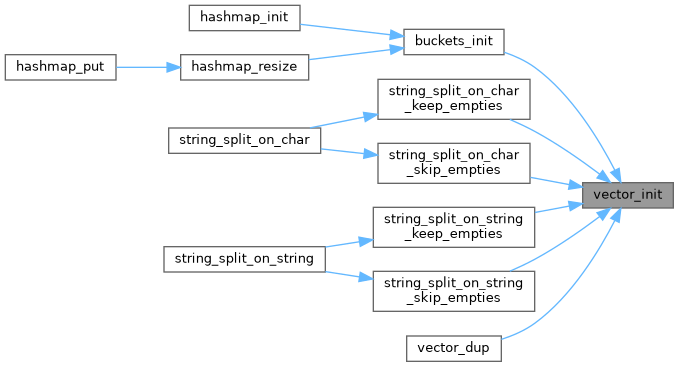
Initializes a vector with a given item size and initial capacity.
- Note
- Cannot fail when cap == 0.
- Warning
- vector must NOT already own allocated data. Call vector_free() first if needed.
- Parameters
-
vector Pointer to the vector to initialize (borrowed, uninitialized). item_size Size of each item, in bytes (must be > 0). cap Initial capacity, expressed in items.
- Returns
- true on success, false on invalid item_size, overflow, or allocation failure.
◆ vector_insert()
| bool vector_insert | ( | t_vector * | vector, |
| size_t | index, | ||
| const void * | item | ||
| ) |
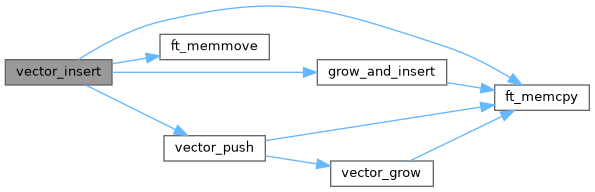
Inserts one item at a specific index.
Existing items at and after index are shifted to the right. Vector is automatically grown if necessary.
- Warning
- vector must be initialized before calling this function.
- item must NOT point inside vector->data.
- Parameters
-
vector Pointer to an initialized vector (borrowed). index Insertion index, in range [0, vector->len]. item Item to insert (borrowed, not modified).
- Returns
- true on success, false on invalid index or allocation failure.
◆ vector_merge()
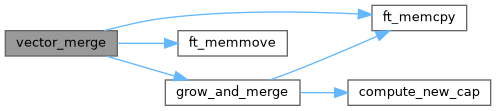
Inserts all items from src into dst at a specific index.
Items are copied byte-for-byte from src into dst. Source and destination storages remain independent after the merge.
- Warning
- dst and src must be initialized before calling this function.
- dst and src must be different.
- dst and src must use the same item_size.
- Parameters
-
dst Destination vector receiving the inserted items (borrowed). src Source vector providing items to copy (borrowed). index Insertion index in dst, in range [0, dst->len].
- Returns
- true on success, false on invalid input, overflow, or allocation failure.

◆ vector_pop()
| bool vector_pop | ( | t_vector * | vector, |
| void * | dst | ||
| ) |
Removes the last item from the vector.
If dst is not NULL, the removed item is copied there before removal.
- Warning
- vector must be initialized before calling this function.
- Parameters
-
vector Pointer to an initialized vector (borrowed). dst Optional destination buffer receiving the removed item (borrowed, can be NULL).
- Returns
- true on success, false if the vector is empty.


◆ vector_push()
| bool vector_push | ( | t_vector * | vector, |
| const void * | item | ||
| ) |
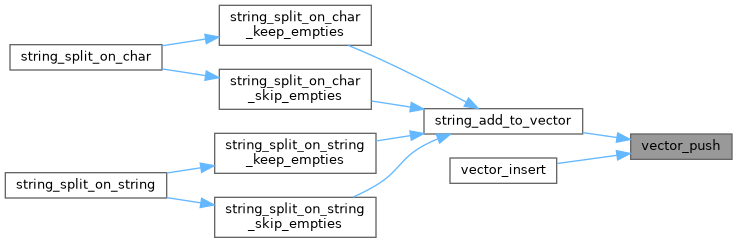
Appends one item at the end of the vector.
Vector is automatically grown if necessary.
- Warning
- vector must be initialized before calling this function.
- item must NOT point inside vector->data.
- Parameters
-
vector Pointer to an initialized vector (borrowed). item Item to append (borrowed, not modified).
- Returns
- true on success, false on allocation failure.

◆ vector_remove()
| bool vector_remove | ( | t_vector * | vector, |
| size_t | index, | ||
| void * | dst | ||
| ) |
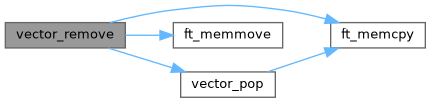
Removes one item at a specific index.
Items after index are shifted left to fill the gap. If dst is not NULL, the removed item is copied there before removal.
- Warning
- vector must be initialized before calling this function.
- Parameters
-
vector Pointer to an initialized vector (borrowed). index Index of the item to remove. dst Optional destination buffer receiving the removed item (borrowed, can be NULL).
- Returns
- true on success, false if index is out of bounds.
◆ vector_take()
Transfers a vector state into another one without copying items.
After the transfer, dst receives the previous state of src. Then src keeps its data pointer and len, but no longer owns the storage because src->cap is set to 0.
- Warning
dstandsrcmust be different.
- Parameters
-
dst Destination vector receiving the transferred state (borrowed). src Source vector whose state is transferred (borrowed).